Preliminary Task - Brief

Continuity task involving filming and editing a character opening a door, crossing a room and sitting down in a chair opposite another character, with whom she/he then exchanges a couple of lines of dialogue. This task should demonstrate match on action, shot/reverse shot and the 180-degree rule.

Preliminary Task - Finished Sequence

Main Task - Brief

The titles and opening of a new fiction film, to last a maximum of two minutes (all video and audio material must be original, produced by candidates, with the exception of music or audio effects from a copyright-free source).

Main Task - Finished Sequence

Why Kris is amazing

Hi I'm Kris and to the right (beneath useful links, labels and blog archive) there is a picture of me :D >

I look that smart every day really, even at school where I am currently studying media.

I love film and taking pictures, and if you scroll down the page you will see some random examples of this I have managed to dig up..

Anyway, on here I will be posting all my AS media foundation portfolio work and basically it will be pretty amazing...


Friday, January 30, 2009

Evaluation - Question 6

"What have you learnt about technologies from the process of constructing this product?"

The first thing I learnt was how to blog using http://www.blogger.com/, which I believe is a much better way of displaying portfolio than folders/files or Powerpoints as it is quicker, easier to display things such as photos and videos and it is easy to link to other websites in order to explain fully what you mean.

I have a list of hardware and software we used which I will refer back to in this post (see pre-evaluation summary).

Things I learnt whilst shooting:

  • I learnt how to use our Canon mini-DV HD cameras and its basic features such as setting it up with battery and tape, the zoom button and recording (we did not use HD tapes because they are expensive and would slow down our school computers, which have not yet been updated with correct HD settings). We learnt how to run the camera on batteries, not mains, so it was versatile with the tripod and we could shoot handheld shots.
  • I learnt how to play the roles of director, assistant director and sound director. As director we were told to ask, "Sound? Camera rolling... and, action!" and we were taught to run the camera for a couple of seconds either side of the action to make it easy to edit and not miss any action. Assistant director held up the clipboard with scene number and take number and sound director got to wear the headphones to hear what the on-board mics were recording. It was all very efficient.
  • I learnt how to use studio lights (we used three) with barn doors to gain lighting in all different kinds of angles. We also used blue gel clipped to the front of the lights for our blue effect and a white throw in the background to cover much of the clutter in the scene. We learnt that the lights were very versatile and great to gain extreme varities in light intensity and in colour using different coloured gels. However, they were a hassle to keep having to set up and pack away, and it took them a long time to cool down after using them for a few minutes - this led to an accident on shoot (a burn and smashed light filter). They have to be handled very carefully and the group must take full responcibility in looking after them and themselves.

[Pictures on test shoot: top left - high intensity lighting / top right - video camera use / middle left - use of orange gel on lights / middle right - use of blue gel on lights / bottom left - the camera & lights set up / bottom right - low key lighting.]


Things I learnt whilst editing:
  • I learnt the basic processes of using Adobe Premiere Pro to edit, which included non-linear editing. It gave use the chance to switch between different sequences and timelines. We had a practise timeline in which we pieced together random strings of shots that we thought might look good in our actual sequence. The ones we liked we copied and pasted into our real timeline. We also used another sequence to cut together some outtakes. It was very easy to do all these things in one project and mistakes were easily undone, so there was no pressure - we could relax whilst experimenting.
  • I learnt some new processes I had not come across before in this particular editing software (which we have used for a previous project). I learnt how to layer shots, vary speed and duration of shots, vary volume and sound levels using markers, ghosting using the cross-dissolve transition, transferring files between PC and Mac, and frame by frame editing in Paintshop Pro (to eradicate a schoolbag in the background of a scene). I was used to these processes by the end of the project and from now on I am probably ready to move on to more advanced settings.
  • I learnt how to use Adobe After Effects (another part of the Adobe creative suites - CS's) to make our titles special. This was done by editing each individual letter for our title seperately and putting a glowing/fade in effect on it, whilst also setting markers on transparency to make them flicker. We put an order to when each letter faded in and put them all together as one animation in which random letters came in at different times to spell 'Reservation'. From now on I will probably use the programme to create titles. Other programmes I briefly used were Livetype and Handbrake on iMac, Livetype had built in animations that we never used because they were not what we were looking for, and Handbrake we used to enhance our scream sound at the end by mixing it with a sound ripped from a DVD, which did work in the end. It was Jack who used this programme more so I did not learnt how to use it properly.

[Picture - our edit suite.]


At the end of the project we discussed ways we think we could improve the teaching in the media department to teach students even more about technologies they could be using for years to come:
  • We agreed more should be taught about using the manual settings on the Canon video cameras as we had a problem with blur during inconsistent lighting (our flickering lights kept making the lense re-focus and therefore blur for a couple of seconds). My brother informed me there was a way of adjusting the lense settings so that the focus did not automatically adjust to changes in lighting, and therefore would not move in and out of focus on flickering lights - we did not know how to do this and still don't, but the method is supposed to be simple so could be something we learn early on this course.
  • We thought there could be more lessons on using the lighting equipment as only two groups (including ours) got to use the studio lights and we had to be assisted alot by the media technition in handling them. We thought more could be made use of out of the focus settings on the lights for more filmic effects and to adapt to different surroundings. In the end this was not a problem as our lighting was OK, but it is something we thought we might need to know on future shoots.
Overall, the technology we used was very good for a school media department and for an AS course. The technology all worked very quickly and nothing was ever too complicated (technological issues were always eventually resolved). I learnt alot of things about using hardware on shoot and software in the edit suite. There are a couple of things I would do differently on hindsight, one being that I would try and challenge myself more on shoot to try out things such as a man-made amateur dolly (a skateboard perhaps) to fix our tripod/camera on and try hard advanced techniques such as a 'Hithcock' contra-zoom or a 360 arc of a subject. The other thing I would do differently would be to research more into the manual settings of the camera, and focus settings of the lights (see improvements to course above). However, with the technolgy and support we recieved, I think we did a brilliant job, and I am alot more prepared for all sorts of new meda technologies in the future.

Wednesday, January 28, 2009

Evaluation - Question 5

"How did you attract/address your audience?"

We addressed our audience by giving them an opening sequence with farmilar forms to others and addressed the horror fans by using horror conventions. We attracted them by getting in touch with their feelings and filling the film with unique attributes.

The opening sequence conventions are mentioned on Question 1 but I will outline them here:

  • Consistent credits with a main title at the end.
  • Clear location and setting (establishing shots of the basement and good mis-en-scene).
  • Introduction of characters (a minute of dialogue and interaction between them to get a feel for their relationship and personalities).
  • Good continuity by use of shot/reverse shot and the 180 degree rule continued throughout the conversation scene. Also, the use of matched on actions such as the killer putting the victim to sleep with the cloth before pulling his arm away in the next shot as he turns to leave the victim sleeping (1.40 mins). This prevented distraction from the film because of lack of flow in the continued story.
  • Use of enigma codes to get the audience to interact and fall into the film world.

The first thing we did to appeal to our audience was chose a popular genre with our core audience of 18-25's, and we thought horror was extremely popular, especially the 'Saw' and 'Hostel' films. Therefore we had to conform to their expectations by making our horror similar to that of the 'Saw' films.

My favourite aspect of the openings to 'Saw' was the variety in pace. It began very steadily, holding back lots of information and the actual appearance of the characters. Instead it focused on miscellaneous objects such as walls, pipes and bulbs, and the characters tied up were revealed bit by bit, with CU's of feet, eyes and mouth, before the shots moved further away from the character. It was 30-40 seconds before the actual character and location was revealed. We tried to achieve this affect in our film with opening credits appearing alongside random objects, helping establish the basement atmosphere, and a confusing montage of the victims face waking up to give a dazed effect. There was not an establishing LS until 33 seconds in, which helped lure the audience. Like 'Saw' the film did not pick up unnecessary pace and continued steadily through the dialogue. [The following compare 'Saw' on the left to 'Reservation' on the right, comparing first victim CU and then lightbulb shots].


There are 2 times when our film picks up pace:
  • When our killer begins to get angry and ends up shouting at his victim (1.27 mins) - he manages to compose himself to bring the film back down to slow pace again (helped by the rise and fall in the musics dynamics).
  • At the end of our film when the hand appears on the door (1.59 mins & below) there is a sudden rise in the music to accompany the shock of the action, ending in total silence and again a slow pace helped by a long mysterious fade to title.

The suddenness of these dramatic moments is amplified by the slow pace of the rest of the film, as tension builds in the audience who are always anticipating something. This helps add a jumpy affect to our film.


Other aspects we focused on to meet expectations of horror fans:
  • Cinematic look with half-dim lighting in a pitch black room, added to by use of blue gel to create a blue tint (right) unique to our film (similar to use of neon green in 'Saw II' - left).


  • A confusing montage of the victim waking up at the beginning (0.20-0.30 mins & below) unnerves the audience by disturbing the time period (similar to scene used in 'Hostel').


  • Scrawly disorganised font on the credits and title (right) add to the confusion, being a bit like messy handwriting as if the person writing them is in pain. It is unsettling how the titles appear almost randomly throughout the sequence in different sizes, and how the title at the end fades in with each letter appearing at different times in no order at all. It created a mysterious code-cracking effect, as if you had to work hard to realise what the title said and that you may have to look deeper into the film to discover the answers (much like the titles in 'Cloverfield (Reeves, 2008)' (left - best picture I could find) are crackled such as on a fuzzy TV set, representing how the film is more meaningful than it looks and you have to search deep for clues [e.g. the last shot of New York which is set in the past before the whole story happened, a faint line can be seen falling into the sea and this is meant to be how the alien reached earth before the film started] because it is artistic.


  • Low-key lighting (right) added to by the flickering lights. We filmed with 3 fairly dim studio lights to highlight shadows in all areas of the characters much like the characters in this particular scene in 'Sin City (Miller & Rodriquez, 2005)' (left) This highlights the expressions of the characters in a particular deep and meaningful scene such as our opening sequence - it is an important part of the story.


  • Realistic atmosphere created by added on sounds (diegetic) such as lighting buzz (0.05-0.08 mins) and dripping water (0.15-0.18), giving our film a new dimension - a "spotlight" kind of effect where every little bit of action stood out and was detailed - bringing the audience into the world of the film (e.g. the amplified dripping water and ringing telephone in 'The Ring' (Verbinski, 2002)) [all added on sounds from http://www.soundsnap.com/].
  • Use of moody music (non-diegetic) to create a tense atmosphere beyond the reality of the film [music called 'The Platform' from http://www.freeplaymusic.com/].
As well as giving the horror fans a farmilar form we had to offer them an original product. What stood out from our opening sequence compared to other sequences and what made it special? Our uniques selling points were:
  • An intriguing plot carrying a hotel-theme and a well-mannered killer. Enthusiasts would want to know why he is acting this way and what the hotel-theme represents. Our film has a carefully written script, giving the audience subtle hints and clues (e.g. "would you like a glass of water?" said by the killer in a hotel-host kind of way.
  • The title helps promote this plot and stir interest. 'Reservation' refers to a hotel reservation. However, I believe it could have been far more effective if it had been called 'The Guests', which is much more to the point and possibly sinister if not easier to remember. Reservation is too long and has too many meanings, making it not mean much at all to the audience in terms of the plot.
  • Plenty of enigma codes because of heldback information (this links to the point about the pace of the film), raising questions within the audience and making them want to watch more. The ending to our sequence poses such questions as to whose limbs the hand and foot were and how these victims got there (see 1.50 & 2.00 mins). There is loads of information still to find out (character details such as names are not known at all yet).
To make our sequence really special we tried to tap into the feelings of our core audience so they would almost physically participate in the film. We did this by hitting at audience pleasures, fears, reactions and popular themes.

We focused on audience pleasures and physical reactions:
  • We made our opening scene very intimate with the tight claustrophobic location of the basement (low ceilings and not much space) and the expressions of characters were highlighted by low-key lighting. A combination of good script-writing and excellent acting made the dialogue scene very intense. The audience would immediately feel sorry for our victim as he seems innocent (he is a lot smaller than the killer and is almost being bullied) and the humiliation and tease of this victim seem unnecessary. All the audience can see of the killer is evil as they do not know about his past and just think he is getting a "kick" out of torturing and killing people. Our scene plugs into the audiences emotional pleasures as they are on a characters side and may begin to care for the safety of this character. In scenes where the killer is particularly evil just provokes more of this responce to the film, with emotions such as sadness, anger, sympathy and desperation (we feel these emotions watching films such as 'Saw' as we capture the intense desperation of the characters in their situations due to the realims). The audience are helpless to do anything and may forget the character is fictional.
  • Emotional pleasures can lead to visceral pleasures, which are the stimulated physical reactions of the audience to our film. Our opening sequence could provoke many, with sadness causing tears, wittyness causing laughter and anger causing people to tense up. Other than these emotions, the actual sequence itself is stop-starty and up and down a bit like a 'rollercoaster ride'. The pace quickens and slows with the music and the anticipation is high to go with the shocks that make people jump and the twists that make people admire the film in a physical way (i.e. shaking their head in disbelief or crying out). The most common physical reaction to emerge from watching our sequence is a sense of revulsion to what the killer is implying subtly and how he strokes the crow-bar. People cringe thinking about what might happen to the victim as you can faintly see the weapons lined up in the background. The audience are scared the film will become gory and they might often feel the pain (as you do watching 'Hostel' because it is horribly realistic). From our sequence, the gag being ripped off (0.45 mins) could cause someone to jump back or scream out in pain, and the thought of gore and death can cause a nauseous feeling.
  • The enigma codes in our film provide the audience with something to solve so anyone can predict what might happen and try and link the important information together to find out what is going on (such as in 'Psycho', we try and guess who is commiting the murders). Solving something can give a sense of pleasure and not being able to know something can frustrate the audience until the end of the film when they find out.
  • There is a counter-culture attraction stemming from our film as we release the audience from all rules and regulations. Our opening scene is private, away from authorities, and the killer has complete control. He can do whatever he wants and there are no limits (such as Michael Myers's unlimited power and freedom in 'Halloween'). Our audience get to feel a pleasure from the feeling they have broken rules by watching extreme situations such as our capturing scene.
We also tried to tap into our core audiences biggest fears (see Ortenberg quote, question 4) and most of these were represented by themes of revenge, needless violence and agression as well as life and death. They all stem from real-life experience (see question 2) making the audience fear them more. These fears could be applied to any audience and most horror films try to hit alot of them:
  • A sense of claustrophobia, being trapped or captured.
  • Voyerism and the idea of being constantly watched or monitored.
  • A sense of being alone in a situation in which you have to try and save yourself with your own thinking - nobody else knows where you are.
  • Sense of darkness and night time and being stuck in a creepy-looking location.
  • Being surrounded by strangers and bodies.
  • Fear of the unknown, what is happening to the victim?
  • Fear of the anger of someone you don't know and cannot reason with.
  • Fear of unbelievable pain that you cannot defend.
  • The fear of death and never being able to see loved ones again.
We see these fears in other people because of the bad things that happen around us and on the news, but we never actually think it will happen to us. This makes us fear them more. Our audience will be unsettled and worried throughout our sequence as they have all these fears to think about and mull over in their minds.

We applied all these audience factors to our sequence and every decision made that I discussed in this question was made for a reason. It is hard to sum it all up in one question so I tried explaining some thing in detail and others in less detail, but they were all meaningful to appealling to our audience. Whether they were successful or not was down to our audience feedback.

After having an audience screening in front of thirty 17-18's we were able to summarise their opinions and criticisms. It was successful feedback with 11 sample questionnaires (many who had a particular interest in horror) all stating that they enjoyed our sequence and thought it was attractive, so our attention to detail in image and style were helpful. Good points for the film were its clear narrative, depth in the killer's character, scariness of the killer's acting and the shock of the hand at the end. This was very pleasing with both dramatic parts being effective on the audience and making them react (everybody in the room jumped at the shock-ending). The holding back of the pace must have worked to amplify the jumpy moments. There was some constructive criticism; not everybody liked the lights flickering because regular intervals of darkness remained distracting (right). This is something we had thought about before but could not eradicate after shooting. People also had their reservations on the title, which I discussed earlier in this question. The last critical comments were mainly on our victims's acting when the gag was pulled off (0.45 mins) and that this could have seemed more painful and shocking (left). This was a hard shot to film as the gag kept coming off for certain reasons, so we understand how this moment seemed particularly flat at the time. I believe our groups attempts to appeal to this type of audience was very successful (most people stating their desire to continue watching). This was also evident in feedback I recieved elsewhere with my brother and cousin (both between 18-25 years old) getting a feel for the film and being more involved in possible improvements, whereas as 40 year olds like my mum were confused by the plot and dazzled by the lights - so did not get the modern horror genre so much.


Tuesday, January 27, 2009

Evaluation - Question 4

"Who would be the audience for your media product?"

In Question 3 I discussed how our film opening would be distributed in cinemas so on answering this question this has to be takin into account.
The Core audience for visiting cinemas regularly in the UK is 15-24's according to this survey taken in 2007 (a good survey to base our intentions on as it focuses on the UK, with our film not likely to travel beyond the UK on first release, being a low-budget movie):

It states that 42% of 15-24's attend the cinema at least once a month (this is more important than the once a year category) compared to other age brackets - the highest being 7-14's at 28%. I think this is a fairly good representation of age diversity in cinema audiences with the teenagers and young adults being the core market for most films - I think ours would be the same.

Our film is likely to merit an 18 rating due to its frightening and violent nature. Therefore our core or primary audience is more likely to represent 18-24's at the cinema (children under 18 would be a big part of our DVD campaign but not for the cinema). I would round this up to a core audience of 18-25's.

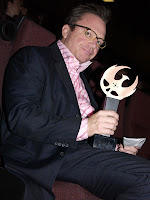
Obviously our main audience will be the horror enthusiasts and especially fans of the 'Saw' and 'Hostel' films, who were likely to share a similar core audience. I tried to find statistical evidence of this but I found this difficult. Instead I managed to find this quote by Tom Ortenberg (see pictures below) - Lions Gate, President of Releasing (upon releasing Saw II):

"We were confident going into this weekend as the only new horror release that we would hit our target audience of genre fans, but this has exceeded all our expectations. With 'Saw,' James Wan and Leigh Whannell have tapped into filmgoers' most base fears and have created something that people immediately feel they need to talk about with others, and see again to catch clues they may have missed the first time."

Tom mentions the target audience of genre fans, meaning the fans particularly of the "gore" subgenre and many classic horror fans interested in the spread of niche modern horror. He also mentions how the film tapped into the audiences worst fears, which I believe ours does (trapped situation, claustrophobia, torture weapons, death and blood) - so our film would maintain a similar appeal, especially to the adrenalin "junkies" and thrill-seekers out there, but also to those with any interest in the genre. Our film (sequence) could basically attract any age if they share these interests, but is important to focus specifically on the 18-25 group who endulge most in cinema entertainment, and for a film it is cinema audience ratings that matter most in its success. Our wider or secondary audience would definately stretch out beyond this small cluster of ages as there are many horror fans over 25 (considering the horror genre originates from the Sir Alfred Hitchcock Period in the 50's and 'Psycho' was produced in 1960 - youngsters from this era will now be in their 60's so some are certainly going to share an interest in how horror has developed).

Gender-wise, our core audience would involve both because of the following points:

  • Teenagers and young adults often hang around in mixed gender groups (cinema visits can be a frequent occurance for these groups).
  • Horror maintains a strong appeal for couples, especially young couples, on a date (the frights give them a good reason to cuddle and get closer to one another early in the date).
  • The film sequence could be seen as male-orientated, in that the actors involved are men and the film involves alot of "masculine traits" - however this is just a generalisation.
  • 'The female gaze', derived from Laura Mulvey's 'male gaze' theory (http://en.wikipedia.org/wiki/Gaze), states that although females provoke the gazes of men because of their bodies, males can provoke the gazes of women if they are involved in a private environment as it creates a sexual kind of atmosphere. This can cause females to be attracted to male actors in films (our opening sequence could create this atmosphere as it is private and intimate), and this is a natural reaction (known as scopohilia in medical terms) so is likely to work well. [Scopophiliais the sexual interest in or practice of spying on people engaged in intimate behaviors, such as undressing, sexual activity, or other activity usually considered to be of a private nature - http://www.dictionary.com/]

Overall, there is appeal for both genders and all ages, as long as they hold an interest in the horror genre (or even if they are with people who enjoy horror). Our film would target a core audience of 18-25's (the cinema-goers) and fans of the gore and torture sugenres (or modern horror in general). The mass of this audience would be national (although local to London, our home city, to begin with - see question 3) because of main distribution in the UK.

Monday, January 26, 2009

Evaluation - Question 3

"What kind of media institution might distribute your media product and why?"

There are two ways of looking at our film - from the perspective of an amateur film and from the perspective of a real film.

If it were treated like an amateur film (such as it is) then it could be entered into a student film festival such as Exposures:
http://www.exposuresfilmfestival.co.uk/.
This is the UK's largest festival of film and image work. However, our project would likely do alot better in a less profile festival such as a competition. There are plenty of these around (for example, last year's Orange 60 Seconds of Fame sponsored by Bafta). However, sometimes these require regulations we cannot fit (for example, our film is two minutes, not one). The most likely distributor of our amateur film would probably be an institution specialist to horror. Here is a low-profile film festival I found in the US, dedicated to horror films:
http://www.britfilms.com/festivals/browse/?id=042A214607a4929CEDnPtJ8CF234.

Something like this in Britian would be ideal, especially one dedicated to modern niche horror. The best one I could find was this film festival in Nottingham held over Halloween week in a special arts centre, screening hundreds of student horror films:
http://www.mayhemhorrorfest.co.uk/festival.html.
This seems ideal for our piece, Reservation.

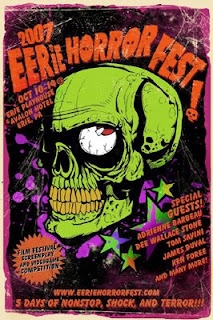
Example of a poster for a film festival - Eerie Horror Fest 2007:

Thinking about our film as a real film in the real film world, it would be distributed by bigger institutions. Our actors are unknowns and not "stars" - actors used to sell a movie as a blockbuster (e.g. Brad Pitt). We chose our actors as to not distract viewers from the story because if was the killer he would be known as Johnny Depp and not as a messed up individual character with depth ('Michael Myers' in 'Halloween' was not a well known actor but became a classic horror character, which was more our intention). Our film would not get the publicity of a blockbuster but I believe it has the potential to be shown in a normal mulitplex cinema.

Our film company, 'Live Wire', would finance some of the distribution as would our production company 'Wall & Bayliss Productions'. 'Live Wire' would finance the makings of many films, from action thrillers to teen movis. 'Wall & Bayliss' are more specific to this particular dark subgenre - they are a modern horror film production organisation. Other companies likely to be interested in maybe joint-financing our film would be the likes of 'Twisted Pictures' and 'Lions Gate Films' ('Saw' & 'Hostel'), as they are similar films and likely to be endorsed and advertised in the same way. Like these two films, our film is not mainstream but is part of a new breed of modern niche horror, which is very popular with a certain audience. It has unique selling points such as the artistic blue tint and unique storyline breaking conventions. It also has many similarities to real films (this trailer of 'Hostel' being close to how our film would be advertised:
http://uk.youtube.com/watch?v=JBxOjTaUpFM).

'Saw' was extremely successful as it firstly appealed to horror enthusiasts before it became a huge film brand ('Saw V' recieved the highest box-office ratings this Autumn in Britain, 2008). There is no reason why our film could not enjoy success in big cinemas such as Cineworld and The Odeon, as it would benefit from past successes in the subgenre, and would offer a new exciting approach for the horror lovers of the cinema.


To get our film into the cinemas we would need to link up with a distributor to sell our film to the big cinemas (the cinemas are owned by the exhibitor companies, who show the films). 'Lions Gate UK' is part of 'Lions Gate Films' who distributes in the UK, so we could have a good link there. We would not be likely to gain the services of a big distributor such as 'Universal' but could target smaller ones such as 'Revolver Entertainment' who do specifically thrillers or 'Tartan films' who have distributed low-budget horror films such as 'Black Christmas (Morgan, 2006)'.


The distributer could firstly distribute to cinemas in London and see how viewings are for a week. The results of this would control whether we began distributing to other regions in the South and then into the North. A good advertising campaing and strong word of mouth could help profoundly. Lastly, we could promote our films in targeted countries such as Japan who are renowned for horror-making. The more successful our film is in these countries the closer we could come to releasing across the rest of Europe and even in America. Global success would be unlikely for the first film release by the production and film company, but the potential could possibly be enhanced by solid advertising and good links with other companies.

Our film would be likely to be released on DVD after cinema showing, depending on the success of the movie. Any DVD-writing company such as 'Excelsior Film & Video', who transfer from cine to DVD as well as duplicating the DVD's:
With the backing of raised finances from cinema screenings of the film, and the production companies, we could distribute our DVD's across the UK if our film was successful (maybe across London if our film was not so successful).

To summarise, as an amateur film ours would be screened at a student film festival specifically for low-budget horror films in the UK. This could be shown in a special arts cinema. As a real film, our production and film companies could link up with bigger companies of similar genres to add finance backing and increase the potential of people our film could reach by good promotion and advertising. It would be distibuted by a distributo specific to horror and fairly cheap. The success of the film would depend on how far it would spread across the country and globally - and also if the film would be released on DVD after with the help of a platform converter company (from cine to DVD). With a good distribution strategy and relations between bigger institutions our film would have the potential to challenge the successes of the likes of 'Saw' and 'Hostel'.

Evaluation Question 2

"How does your media product represent particular social groups?"

Upon analysing the characters in our film opening, you can see they are both very different.

Our victim:
  • Fairly short.
  • Tough looking - shaven head.
  • 18-20's.
  • Wears a "hoodie" and jeans.

He is a typical British youth, nothing makes him stand out from anyone else - not much to his mis-en-scene. He is normal and could represent anyone.

Our Villain:
  • Very tall.
  • Tough-looking.
  • Messy, long hair.
  • 20-30's.
  • Wears a long, dark coat.


In many ways, our villain is a normal looking man on the outside - his dress is almost work-like. Like the victim, he too could represent anyone in the outside world, simply with more years and more experience than teenagers to young adults i.e. the victim.

The difference between the two is in their characters. The victim's character is not obvious, but we know he has some guts as he tries to find out more about his horrible situation, despite the tremble in his voice. He does what many other men his age would do; assess the situation, try and retain some control and show they are not scared when they really are (seen with the alpha-male characters in 'Saw', who act "hard" but cannot take the life-and-death situation - see image below). This attitude is always seen in Britian with young men standing up to authorities and always wanting the power. Put many of these men in this situation and they may struggle to find their fearless masculine side when they really need it. Panic or loss of control could result in death, and it is this that our victim is finding difficult to grasp. He ends up provoking the wrath of his killer with too many questions, who forces him to sleep. A different, calmer approach may have lead to more answers, or maybe even his safety.


Our villain has an arcetypical character with more depth. On the outside he could represent anyone, but on the inside he can only really represent very few people. He shows friendliness but can switch at any moment. He swings from calm to angry very quickly and his feelings are very up and down - he seems to be driven by confused emotions. This kind of bi-polar character has developed in many people in the real world with mental illnesses focused on anxiety and anger (e.g. Paul Gascoigne). These often stem from past experiences, so the same could be the case for our villain - it is not yet known. He could represent these misunderstood people as it is not always obvious what they are feeling, it cuts them deep down on the inside and often drives them to insanity and to do dreadful things such as murder. Particular examples of this kind of mentally ill character are 'The Joker' in 'The Dark Knight (Nolan, 2008)' (see image below) and the schizophrenic character of 'Norman Bates' in 'Psycho'. I have read how people build up depression inside and often they just want to release their anger on the world, on the normal people living normal lives - so this is where our victim comes in. Without representing a particular social group, our film more represents the misunderstood individuals who do not believe they are like the rest of the world or have a place. They may just want to prove a point to relieve the stresses they have built up inside them.


Another point is that the killer is acting. He shows kindness and hospitality as would a worker at a hotel or shop. He insists on getting his victim a drink of water because he looks dizzy and keeps telling him everything is going to be ok. It is as if the killer paints on this picture of him being a civilised human to mask his internal rage. He treats the whole situation as if he is a hotel owner making 'reservations' for his victims as if it is the only way he can remind himself he is a normal person - it is how he deals with his emotions until he gets too angry (similar to how 'Norman Bates in 'Psycho' comforts himself by acting as his mother almost as if it has become a part of him - see image below).

Specific thing we did to construct these representations:

  • Focused on very normal clothes and make up of characters - their mis-en-scene always represented that of any normal person.
  • Inserted many questions into the victims script to highlight his confusion and terror, encouraging his representation of young British men in such a situation e.g. "where am i? what am i doing here?!"
  • Made music rise and fall with the killers emotions to highlight his calm state of mind and sudden anger, so his mood switches are extremely clear.
  • Clever script writing for the villain, with subtle hints at hotel-like vocabulary e.g. "we try to accomodate all of our guests as best we can".
  • Positioned the killer to have complete control over his victim, taking up the bigger spaces in most scenes and being tall and imposing (we specifically chose a really tall and really short actor to fit these parts) - we can see who is in control and how the killer is exploiting this control - it makes us think of revenge because he is grasping hold of this power.

This brings us onto themes our film opening portrays:

  • Revenge.
  • Violence.
  • Life and death.

They are all very sombre issues but are actually seen in every day life. Revenge is a big factor in sports or relationships and is something we all experience. Violence can be seen all the time in gang-violence or in wars elsewhere in the world - we see it all the time on the news. Upon encountering such things we also encounter life-or-death situations (though we might not have thought to deeply about such a saddening theme). With all these themes, it is only when we are faced with them personally that it will affect us. Maybe we are not so much unlike the killer after all, maybe humans are all the same, and it is only their experiences and learnings that determine how they deal with their feelings. Of course the audience will not see this, they will only see the fact he is torturing and killing an (The sequence is 'in your face' and affects the audience emotionally as they have to endure the victims suffereing). The audience will immediately hate the killer - this perhaps proves how misunderstood people can become isolated and will often always remain misunderstood upon first impressions and misinterpreted actions.

To summarize, the characters in our film have different roles to represent different social groups. They both represent young adults in Britain, particularly males, with their normal appearances and accents. Our victim represents many alpha-males in the country (not in a negative way put in a way that he is protective of himself) and our killer represents the misunderstood people who have always wanted some sort of power. He can also represent people with mental illness, some who are driven to insanity and commit horrible crimes. Furthermore, our killer masks his emotions by acting like a hotel host - so any hotel or shop workers are represented by him here (many of them put on a smile when they are working because it is their job, but they cannot always be happy). Lastly, the sequence also represents particular themes of revenge, violence, life and death that help make up the day to day stories of our social lives - they are just simply amplified to extremity in the situation our opening sequence portrays.

Evaluation - Question 1

"In what ways does your media product use, develop or challange forms and conventions of real media products?"

Our brief stated to make an opening sequence so we researched into the conventions of an opening sequence and how they do the following:
  • Give the film a farmilar form for the audience to follow.
  • Set the scene.
  • Introduce the film plot and lure the audience in.
  • Make the genre clear
Our opening sequence follows forms similar to 'The Descent (Marshall,2005)' opening, with credits fading in and out for the duration of the opening sequence before fading to the main title, 'Reservation', at the end. This is the farmiliar form of a film opening sequence.

Click link for The Descent clip.
(http://uk.youtube.com/watch?v=WWF6_rSyYcY&feature=PlayList&p=762617D7BA39EF4B&playnext=1&index=21)

We set the scene of our film well by introducing the eerie basement location with the first three shots (pictures from left to right - flickering lights, cracked brick walls and dripping pipe), with the murky darkness of the basement remaining vital to the chilling atmosphere we wanted to portray.


We set up the film plot gradually, although the outline of it was quite obvious from the setting. The minute of dialogue between the two main characters did not give the plot away but introduced important traits such as the killer's apparant politeness, but sudden streaks of anger (an example of binary oppositions used in Levi-Strauss's narrative theory; good and evil). The reasons for this temprement remains unknown to the audience, creating an enigma (we researched how enigma codes are used in opening sequences to lure the audience into watching the rest of the film - Roland Barthes's narrative theory), as does the reason for the capturing. All the audience know is that the killer is keeping multiple victims in and abandoned basement.

Example enigma from 'Reservation': The killer picking up the crow-bar provoked the victim to fear him, but he returns it to its place. What is the killers intention? Is he actually going to kill him?

The genre we focused on most was horror.

To introduce the genre, our opening used the following conventions of horror to appeal to horror fans:

  • Moody, mysterious, unsettling music, rising and falling with the dramatic action - loud parts accompanied the killers anger whilst quiet parts gave a lonely, silent feel (e.g. the dramatic music in 'Psycho (Hitchcock, 1960)' is only used during the killings, otherwise it is silent).
  • Typical horror mis-en-scene; dark and murky location, low-key lighting, dark-clothed killer, shadows, night-time (e.g. the lake location and night-times used for the killings in 'Friday the 13th (Cunningham, 1980)'.
  • Fade transitions to give an unknown time period, with the cross-dissolve montage of our victim waking up being confusing (e.g. 'Hostel (Roth, 2005)' uses this to introduce its first victim, tied to a chair)
  • The classic horror narrative pattern - an adaption of Vladimir Propp's character role theory but using villain and victim roles instead of villain and hero (e.g. Mike Myers in 'Halloween (Carpenter, 1978)' killing teenagers who are his victims).
  • Consistent use of continuity in real-time (except the opening montage of location and waking-up clips) including a shot/reverse shot dialogue scene using MCU's with establishing shots of the conversation at LS, and then a sequence following the killer out of the basement strung together with good matched on action.
    A shock/twist ending to the scene - a bloody hand smacking the door glass showing there is more than one victim (e.g. a car crash at the end of the opening scene to 'The Descent (Marshall,2005)').
  • Typical themes of revenge, evil, violence and death - these are not obvious at the start but it is clear the killer has some sort of motive, which could be pure evil or revenge, and it seems as if he has a violent manner. The life of the victim could be at stake but we do not know enough about the killer yet (e.g. killer driven by pure evil in 'Halloween' but revenge is the theme in 'What Lies Beneath (Zemeckis, 2000)' - ours could be either).

A special convention we used to introduce our subgenre as torture, was the dark but brightly-lit basement location for a cold, metallic feel - used in both 'Saw (Wan, 2004)' and 'Hostel' - the most successful torture films to date. This subgenre is part of a newer breed of horror films, so some classic conventions we broke:

  • Our character appeared friendly rather than the favoured stereotypical evil killer.
  • Blue filter gel gave a unique blue-look rather than favoured black darkness.

The first point gave our film an original plot, with the twisted hospitality of the killer being unique. It allowed for subtle irony in his dialogue and the main title (the hotel-like hint in 'Reservation'). This is much like in 'Saw' where the killers intentions of giving his victims the chance to escape by changing their sinful ways is some what admirable.

The second point could be considered a convention of modern niche horror films. 'Saw' (left) often had a blue or green tint and 'Hostel' (right) was more yellow.


The last convention of a real film we broke was the classic narrative pattern (Todorov's narrative theory - equibrium then disruption then resolution). Our film opening did not begin at equilibrium but began with a disruption, the victim having been captured. Our film could go back to an equlibrium point after this opening and work its way back to this disruption point before offering a resolution - a technique used by many films in some forms of the horror/thriller genre (e.g. 'Severence (Smith,2006)' from the comedy/horror genre and 'Goodfellas (Scorsese,1990)' from the thriller/gangster genre).

As well as breaking conventions, our film opening tries to create its own unique style similar to that of the 'Saw' films:

  • Slow paced and heldback information.
  • Moments of faster pace for dramatic, jumpy effect and to highlight key information revealed.
  • Cold, metallic feel to the basement location because of the blueness of the image.
  • Confusion points that delibrately unsettle the bye use of cross-dissolve , stop-start rhythm and feel, scrawly uneven credit font and size, flickering lights (although many people commented on how this did not unsettle but more disrupted them from what was going on in the scene).

To summarise, our opening sequence used a mixture of opening sequence conventions, horror genre conventions, enigma codes, modified modern horror conventions and a unique style specific to the torture subgenre as to provide a farmiliar form for all audiences to follow but give them something new and unique - like most real film products do.